



 RU
RU
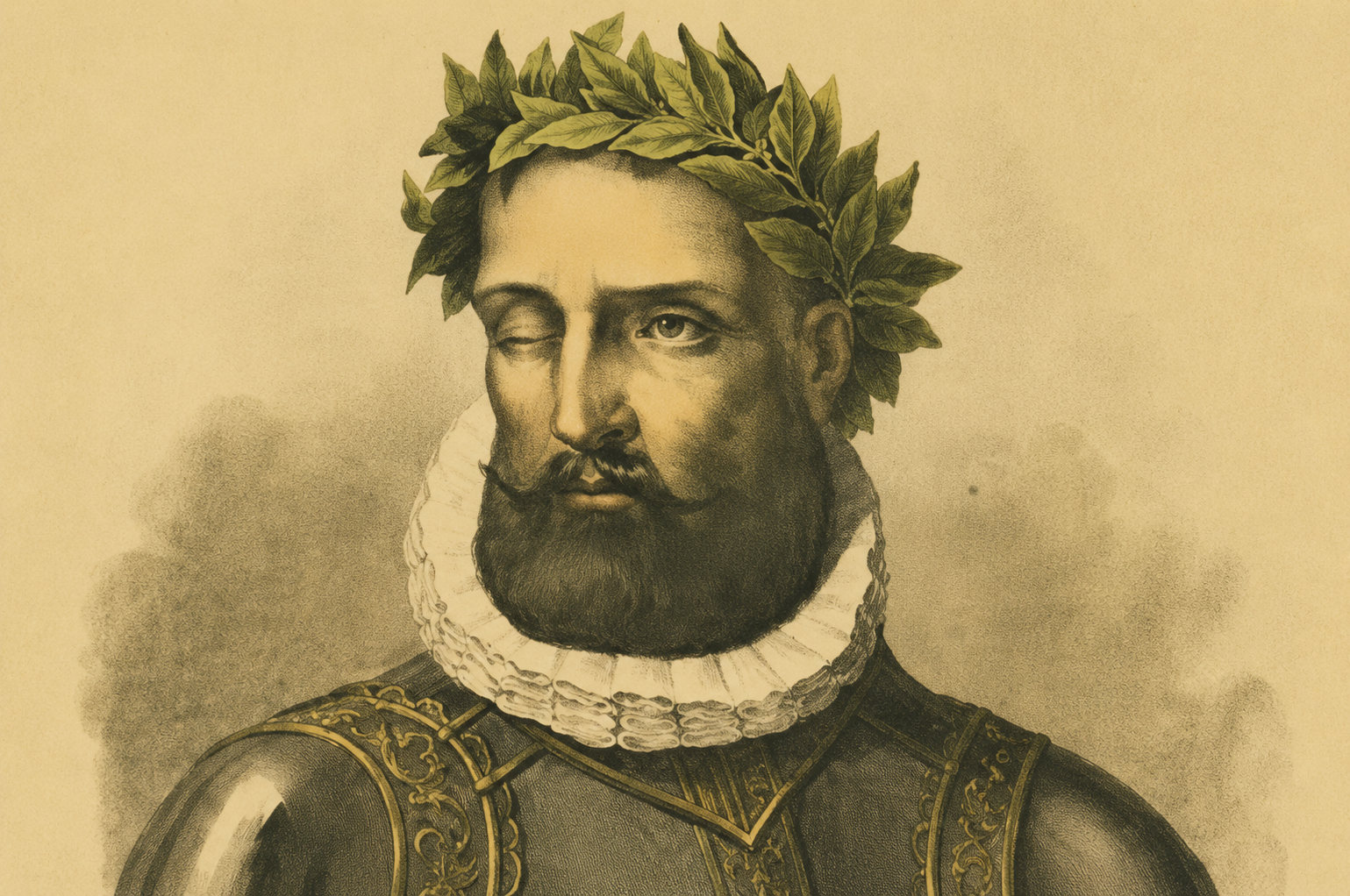
Today, Portugal is celebrating its most important national holiday. Officially, it is the Day of Portugal, Camões and the Portuguese Communities. The date was not chosen by chance: it marks the death of Luís de Camões on June 10, 1580. Often regarded as Portugal’s equivalent of Pushkin, Homer and Shakespeare all rolled into one, Camões remains the country’s greatest literary symbol. Here are seven lesser-known facts about him, compiled by journalist and collector of Portuguese stories Alena Khazinurova
.
1. No one knows exactly where or when he was born.
Most historians believe he was born in Lisbon in either 1524 or 1525, but there is no definitive historical evidence to confirm this.
2. The date of his death became a national holiday.
Every year on June 10, Portugal celebrates the Day of Portugal, Camões and the Portuguese Communities.
3. In Russian he is “Camoens,” but in Portuguese he is “Camões.”
The surname Camões is pronounced roughly as “Camoysh.” The Russian form “Kamoens” emerged through 19th-century European transliterations. French and English scholars struggled to represent Portuguese nasal vowels, replacing the letter “õ” with the combination “oen,” which produced the spelling Camoens. Russian polymath Mikhail Lomonosov later rendered it into Russian as “Kamuyens.”
4. He was both a troublemaker and a notorious ladies’ man.
Camões was frequently involved in street fights, pursued romances with noblewomen, and was eventually exiled from Lisbon following a conflict with a court official.
5. He lost an eye while fighting in Africa.
This is one of the few episodes of his life that historians consider reasonably well documented. While serving in North Africa, Camões lost his right eye in battle.
6. He spent nearly 17 years in Portuguese Asia.
He lived and served in Goa—where he also spent time in prison—visited Macau, sailed across the Indian Ocean, and witnessed a vast portion of the Portuguese Empire firsthand. Those experiences later became the foundation of his masterpiece, The Lusiads.
7. He died in poverty.
After the publication of The Lusiads, the king granted him a pension, but it was smaller than the wages of a carpenter. Additional income reportedly came from a servant from Mozambique who begged for alms in the streets of Lisbon.
8. He is buried at Jerónimos Monastery—but not necessarily.
After his death in 1580, Camões was buried near the Church of Sant’Ana, in what is now the Martim Moniz–Intendente area of Lisbon. However, the church and its cemetery were destroyed in the Great Lisbon Earthquake of 1755. In the 19th century, the poet’s symbolic “remains” were ceremonially reinterred at Jerónimos Monastery. The problem is that his actual remains were never recovered, and no one knows where they are today.
